
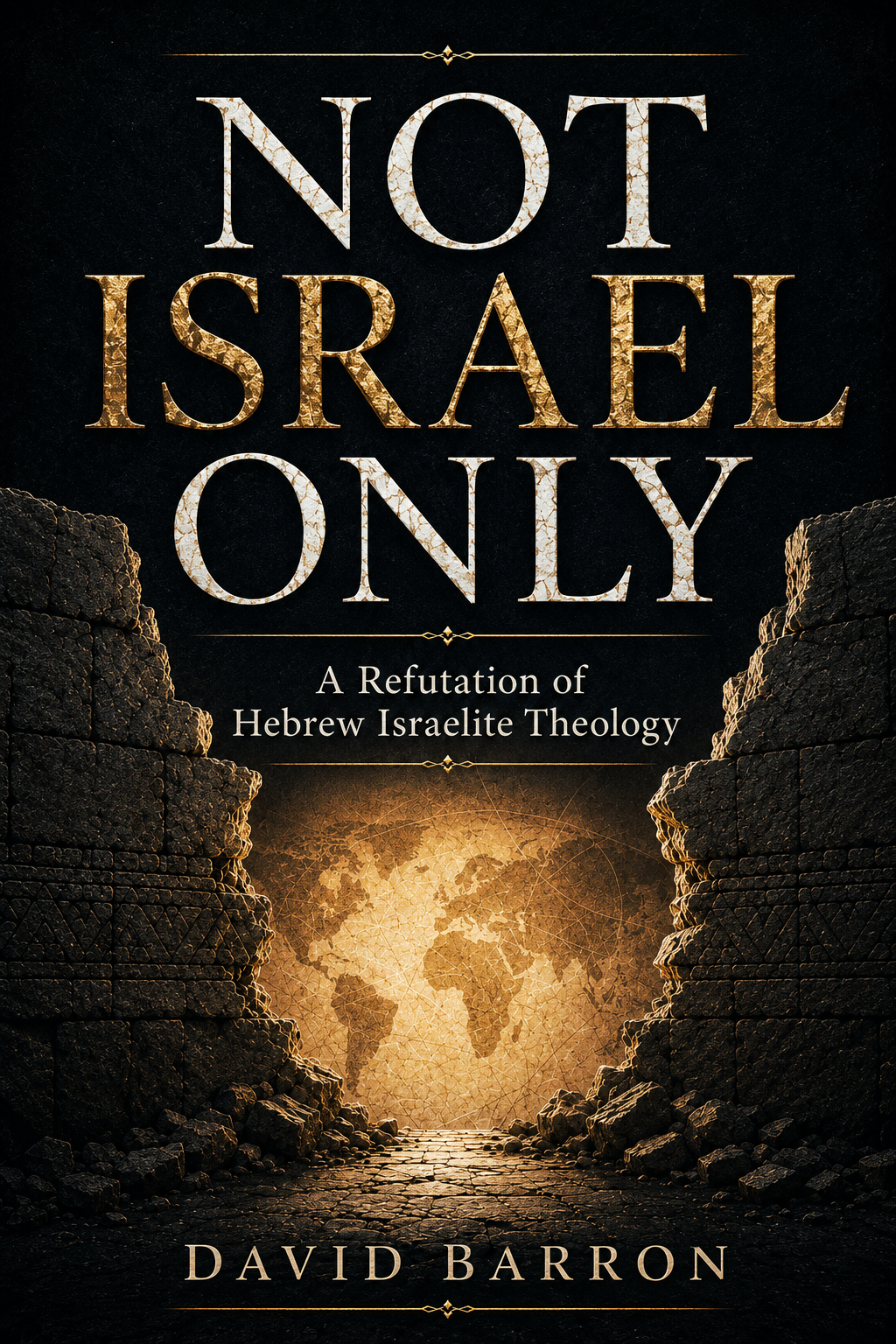
Not Israel Only
A Refutation of Hebrew Israelite Theology
A comprehensive exegetical response to the One West Hebrew Israelite movement's biblical claims — examining each argument in its original linguistic, historical, and canonical context.
What This Book Is About
Over the past several decades, the One West Hebrew Israelite movement has advanced a set of interpretive claims that identify the descendants of the Trans-Atlantic slave trade as the true Israel of Scripture. These claims have drawn thousands of adherents and generated significant controversy — not only in theological circles, but in broader cultural discourse.
Not Israel Only does not engage this movement from a place of cultural antagonism. It engages it where the movement itself demands to be engaged: in the biblical text. Every major proof-text employed by the movement is examined in its original Hebrew or Greek, situated within its historical context, and read within the framework of the whole canon.
The result is a work that takes the movement's exegetical claims seriously — and demonstrates, through careful scholarship, where those claims fail to hold under scrutiny. The goal is not to demean any person or people, but to defend the integrity of sound biblical interpretation and to call all readers back to what the text actually says.
Inside the Book
Thirteen chapters examining the movement's central biblical arguments with precision and care.
The Mixed Multitude and the Stranger in the Land
This chapter shows that the Old Testament covenant community was not permanently closed to foreigners. Through the mixed multitude, the gēr, Rahab, Ruth, and prophetic passages, it demonstrates that non-Israelites could join themselves to Yahweh, participate in Israel’s worship, and share covenant blessings.
The Twelve Tribes and “Jews”
This chapter challenges the claim that the northern tribes disappeared after the Assyrian exile. Biblical and historical evidence shows that members of those tribes remained among the Jewish people, while the term Jew eventually came to describe the covenant people more broadly than the tribe of Judah alone.
Greeks and Hellenists
This chapter distinguishes ethnic Greeks from Hellenized Jews and the Greek-speaking Jews called Hellenists. The historical evidence shows that adopting Greek customs did not make an Israelite ethnically Greek, undermining the claim that New Testament Greeks were simply Israelites who had lost their identity.
The Meaning of “Gentiles”
This chapter examines the biblical words translated “Gentiles” and shows that their meaning must be determined by context. Although the terms can occasionally refer to Israel as a nation, Scripture normally distinguishes Israel from the Gentile nations and does not teach that apostate Israelites became Gentiles.
Hebrew Israelite Arguments
This chapter addresses common Hebrew Israelite “precept” arguments used to restrict salvation to Israel. While Scripture clearly gives Israel priority in God’s redemptive plan, the passages examined do not teach permanent exclusivity and instead fit the broader biblical promise of blessing extending to the nations.
Gentiles and the Apostolic Mission
This chapter traces the expansion of the gospel in Acts from Israel to actual non-Israelites. Cornelius, the Lycaonians, the Athenians, and other Gentile audiences demonstrate that the apostolic mission deliberately moved beyond ethnic Israel.
Salvation for All Who Believe
This chapter argues from Romans, Galatians, Ephesians, and Revelation that believing Gentiles genuinely share in salvation through Christ. They are brought into God’s people through faith, not by being redefined as physical descendants of Israel.
The Virgin Birth
This chapter answers arguments that Joseph had to be Jesus’ biological father for Christ to descend from David. The Gospel accounts consistently present Jesus as truly descended from David through Mary while being conceived miraculously by the Holy Spirit.
Regeneration, Reincarnation, and Resurrection
This chapter examines the Hebrew Israelite doctrine of repeated earthly lives and shows that biblical regeneration refers to renewal, not reincarnation. Scripture instead teaches one earthly life followed by judgment and bodily resurrection.
Are Christians Under the Mosaic Law?
This chapter distinguishes God’s enduring moral standards from the Mosaic covenant established at Sinai. Christians remain obligated to holiness, but the New Testament places believers under Christ and the law of Christ rather than under the Mosaic covenant.
Skin Color in the Bible
This chapter examines passages commonly used to assign modern racial identities to biblical figures. It argues that symbolic descriptions and ancient ethnic terminology cannot legitimately be turned into claims that Jesus or the Israelites belonged to modern racial categories.
Who Really Is Esau/Edom?
This chapter challenges the identification of Esau and Edom with Europeans, Caucasians, or the United States. Scripture and history instead identify Edom as a specific ancient people descended from Esau and associated with a defined territory southeast of Judah.
The Curses of Deuteronomy 28
This chapter examines the claim that Deuteronomy 28 uniquely identifies descendants of the transatlantic slave trade as Israel. The curses are better understood within Israel’s covenant history, including the explicit reference to returning to Egypt and documented instances of Jewish captives being transported there and sold into slavery.
Who Should Read This Book
Bible Students & Scholars
Those who want a rigorous, text-grounded engagement with the movement's exegetical claims.
Pastors & Ministry Leaders
Those who encounter Hebrew Israelite teaching in their congregations and need a careful, charitable response.
Curious Seekers
Anyone who has encountered these claims and wants to know what the Bible actually says — without the polemics.